Discovering San Diego's Historic Spruce Street Suspension Bridge
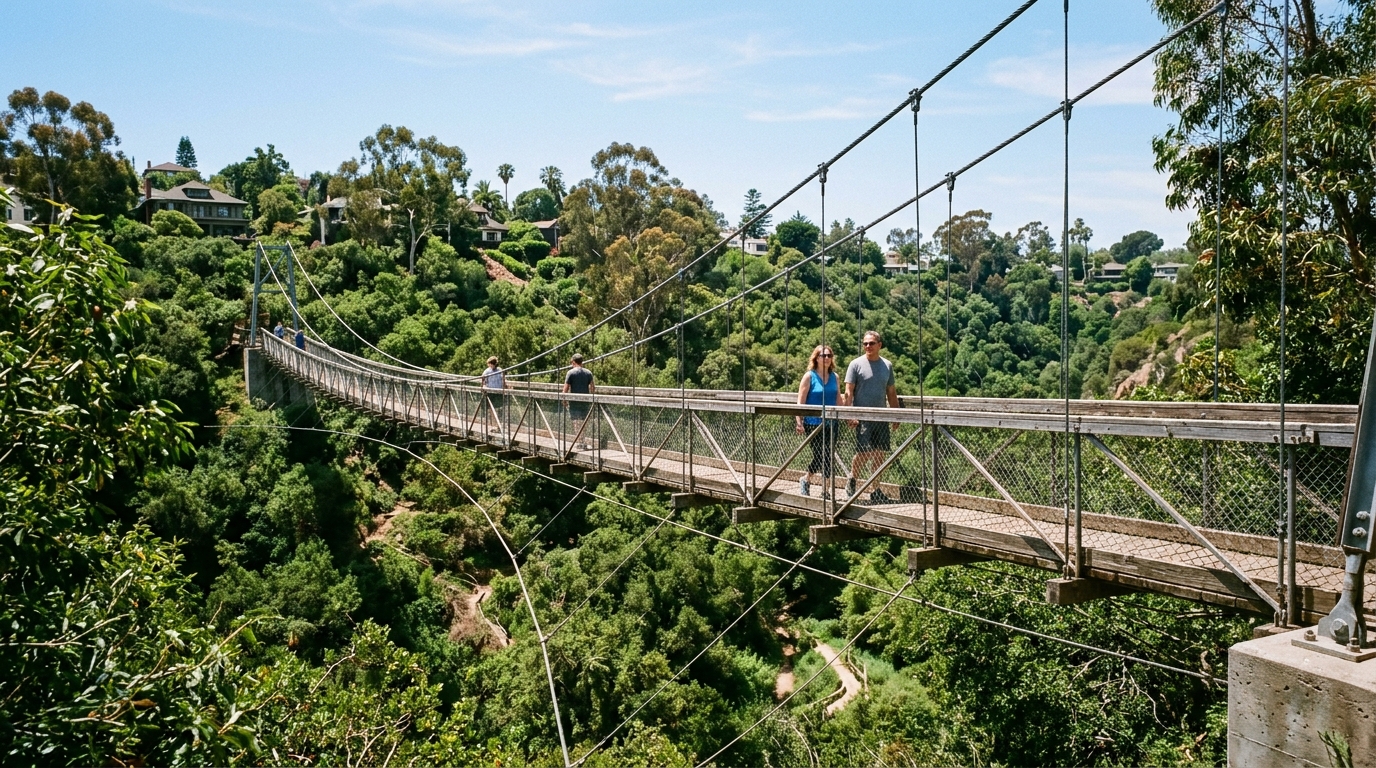
The Trolley Commute: Why Bankers Hill Built a Skyway in 1912
To understand why a swaying suspension bridge hangs over a quiet residential canyon, one must travel back to the rapid urban expansion of San Diego in the early 1910s. The mesa top known today as Bankers Hill (originally dubbed Florence Heights) was rapidly developing into the city’s premier enclave for wealthy civic leaders, doctors, and attorneys.
However, the rugged topography of San Diego presented an everyday obstacle: deep natural coastal canyons sliced the plateau into isolated fingers of land. Residents living west of Kate Sessions Canyon (formerly Arroyo Canyon) faced a grueling daily trek scrambling down dirt ravines and clambering back up steep trails just to catch the newly extended Fourth and Fifth Avenue electric streetcars into downtown.
In 1912, neighborhood property owners petitioned the city for a pedestrian crossing. The municipal task fell to City Engineer Edwin M. Capps. Capps was a visionary, fiercely independent civil engineer who had designed San Diego's early deep-water municipal harbor piers and was later elected Mayor of San Diego for two non-consecutive terms (in 1899 and 1915).
Working with an austere municipal budget of just $19,000, Capps realized that building a conventional timber trestle or steel arch would be prohibitively expensive and require clear-cutting the canyon flora. Instead, he proposed an elegant, minimalist solution inspired by frontier suspension crossings: hang a lightweight pedestrian deck from tensioned steel cables anchored directly into the canyon bluffs.
Engineering the Sway: Tension, Steel, and Harmonic Motion
Completed and dedicated in 1912, the Spruce Street Suspension Bridge was a masterclass in functional elegance. Capps engineered the span using principles that prioritized flexibility over rigid mass:
- The Anchorages: At each end of the bridge, massive pairs of steel suspension cables pass over steel pylons and plunge deep into the earth, encased inside subterranean concrete deadmen buried into the sandstone bluffs.
- The Deck Structure: The walking surface measures 375 feet in length and just over four feet wide, framed with lightweight Douglas fir stringers and cross-planking. Light lattice fencing lines the sides, allowing ocean breezes to pass through without exerting excessive wind load.
- The Harmonic Sway: Unlike modern suspension bridges fitted with hydraulic dampers and rigid stiffening trusses, Capps intentionally designed the Spruce Street bridge to move with the environment. When a Pacific breeze rolls up the canyon from San Diego Bay—or when multiple pedestrians walk across the midspan in rhythmic stride—the center of the bridge gently swings side to side and bobs vertically.
For first-time visitors, stepping out to the midpoint where the deck hovers seventy feet above swaying eucalyptus tree canopies can trigger sudden vertigo. Yet for structural engineers, the flexibility is precisely why the bridge has survived over 110 years of ocean breezes, winter storms, and minor seismic tremors without structural failure.
Visit in the early morning between 7:30 AM and 9:00 AM. Morning marine layer fog often lingers in the canyon bottom, creating an ethereal, cloud-walking atmosphere before the afternoon crowds arrive. While the natural sway of the bridge is part of its historic charm, do not intentionally run or bounce; municipal codes strictly prohibit intentional rocking to protect the historic cable tensioners. Pair your visit with the iconic San Diego Seven Bridges Walking Tour, following Spruce Street east to cross the nearby 1897 wooden Quince Street Trestle and the 1931 First Avenue Steel Arch Bridge.
From Utility Footbridge to Historic Landmark #186
When the San Diego streetcar network was dismantled in 1949 in favor of automotive transit, many historic pedestrian footpaths and wooden trestles across the city were torn down or paved over. The Spruce Street Suspension Bridge, however, was staunchly protected by the Bankers Hill community as an indispensable neighborhood sanctuary.
In 1983, recognizing its engineering ingenuity and cultural significance, the City of San Diego formally designated the bridge as San Diego Historic Landmark #186. Subsequent restoration projects in 1989 and the early 2000s carefully replaced weathered deck timbers, retrofitted safety cabling, and reinforced the bluff anchors, ensuring the bridge preserves its exact 1912 architectural profile.
Today, looking down from the center span offers a peaceful wilderness contrast to the urban skyline. The canyon below is filled with native chaparral, towering palms, and eucalyptus trees alive with hummingbirds and red-tailed hawks, while peeking glimpses to the west reveal sailboats gliding across San Diego Bay.
Visitor Logistics and Planning Your Walk
Planning an excursion to the Spruce Street Suspension Bridge is simple and easily integrated into a wider tour of Uptown and Balboa Park:
- Location & Entrances: The bridge spans West Spruce Street between Front Street (eastern end) and Brant Street (western end) in Bankers Hill, San Diego (ZIP 92103).
- Parking: Free street parking is readily available in the surrounding quiet residential neighborhood along West Spruce, Front, and Brant Streets (observe posted 2-hour limits on weekdays).
- Hours & Admission: The bridge is a public city pedestrian right-of-way, open 24 hours a day, 365 days a year, with free admission.
- Accessibility: The bridge entrance from Brant Street has step-free sidewalk access; however, the wooden deck is narrow and sways under foot traffic, which may be challenging for those with severe mobility challenges or inner-ear balance sensitivities. Bicycles, skateboards, and motorized scooters must be walked.
- Nearby Highlights: Walk three blocks south to cross the Quince Street Trestle (a 1897 timber span across Maple Canyon), explore the hidden canyon trails below, or walk four blocks east to Fifth Avenue for craft coffee and brunch in Hillcrest.


Comments
Post a Comment