The Secret Sea Caves of La Jolla: Descending into Sunny Jim Cave
The Geology of the Seven Sacred Sea Caves
To understand why Sunny Jim exists, you have to look at the powerful geological forces shaping La Jolla’s shoreline. The cliffs flanking La Jolla Cove are composed of the Point Loma Formation—a dense Cretaceous layer of sedimentary sandstone, mudstone, and shale laid down more than 75 million years ago when dinosaurs roamed the Pacific coastline.
Over countless millennia, relentless Pacific groundswells hammered against micro-fractures in the sedimentary rock. Where water found softer silt seams, hydraulic wave pressure hollowed out seven dramatic sea caverns along the coastal bluffs:
- The Clam’s Cave: The largest cavern and the only one visible from coastal cliffs at Goldfish Point.
- Arch Cave: A cathedral-like chamber sculpted with sweeping natural stone spans.
- Sea Surprize: A hidden pocket cavern known for glowing orange lichens and anemones.
- Shopping Cart: Named for a bizarre circular ocean-floor eddy that traps flotsam.
- Little Sister & The White Lady: Delicate clefts frequented by nesting cormorants and brown pelicans.
- Sunny Jim Cave: The deepest cavern of the system, extending over 140 feet beneath the village bluffs.
While the other six caves can only be reached by kayak, paddleboard, or technical open-ocean swimming when swell conditions allow, Sunny Jim stands apart thanks to the sheer obsession of one turn-of-the-century prospector.
Two Years, Pickaxes, and a Gilded Age Vision
In 1902, a German immigrant, mineralogist, and landscape artist named Gustav Schultz purchased the bluff-top cottage perched directly above the caverns. Schultz observed tourists risking their lives climbing down slick seaweed-covered crags to glimpse the tide pools below. Recognizing both a natural wonder and an irresistible entrepreneurial opportunity, Schultz resolved to dig a tunnel connecting his home directly into the giant sea cave below.
Lacking modern hydraulic drills or pneumatic jackhammers, Schultz hired two Chinese laborers who embarked on a grueling, two-year excavation through solid Cretaceous sandstone. Armed only with handheld pickaxes, iron chisels, shovels, and kerosene lanterns, they manually hauled thousands of buckets of pulverised stone up to the surface.
When the tunnel breached the cavern ceiling in 1904, Schultz initially lowered adventurous visitors into the black void using a heavy rope and pulley system for a few cents. As tourist demand surged, Schultz recognized the liability and installed a steep wooden staircase of 145 steps, anchoring heavy timber beams directly into the damp stone walls.
Literary Royalty and Rum-Running Bootleggers
The cave’s peculiar moniker arrived courtesy of a famous visitor. In the early 1900s, L. Frank Baum, the celebrated author of The Wonderful Wizard of Oz, spent his winters in San Diego staying at the Hotel del Coronado and writing sequels to his fantasy masterpiece. Baum visited Schultz’s newly opened subterranean passage.
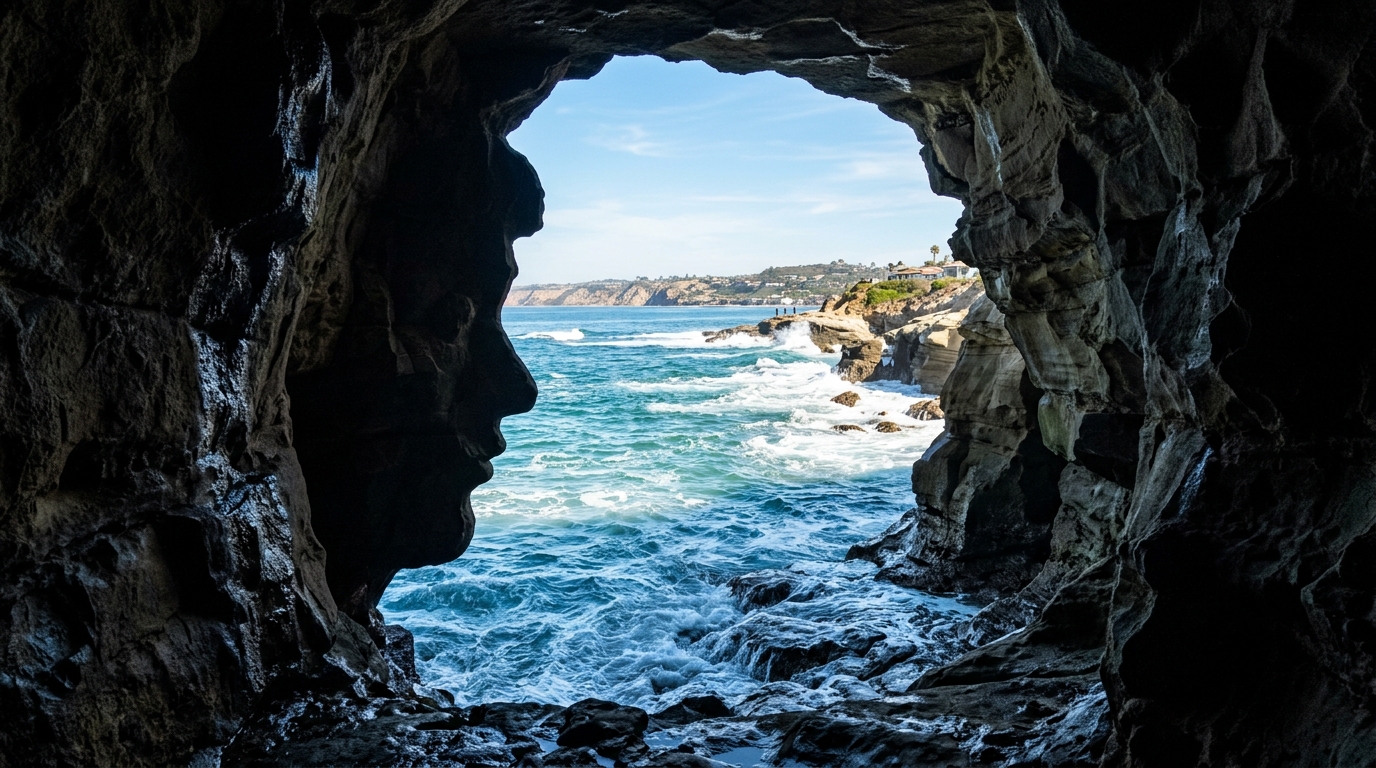
Standing on the viewing platform in the dim cavern, Baum gazed out toward the natural stone opening framing the crashing ocean surf. He noted that the jagged silhouette of the cave mouth bore an uncanny resemblance to "Sunny Jim"—the cheerful cartoon mascot with an upturned nose and slicked-back hair who promoted Force, a popular British toasted wheat cereal of the era. Schultz loved the reference, painted the name onto his storefront, and the title has endured for more than a century.
During the 1920s, the tunnel took on a decidedly more clandestine purpose. Under the nationwide ban of Prohibition, San Diego’s proximity to Mexico made its jagged coastal waters an ideal corridor for rum-runners. Under cover of foggy midnight tides, bootleggers ran small, darkened wooden skiffs from Mexican waters into the mouth of Sunny Jim Cave. Smugglers hauled wooden crates of Canadian whiskey and Mexican tequila up the 145 wooden steps, loading them directly into waiting automobiles parked behind Schultz’s shop before federal revenue agents ever caught wind of the operation.
The Cave Store sells self-guided descent tickets, but during busy summer weekends, wait times can stretch over an hour. Book your 15-minute time slot online in advance via the store's reservation portal. Wear footwear with good traction—the wooden steps and metal railings become noticeably damp and slick from ocean salt spray. For photographers, the prime lighting window is between 11:00 AM and 2:00 PM, when overhead sunlight penetrates the cave opening and turns the surging ocean water brilliant neon turquoise.
What to Expect Inside: Descending into the Abyss
Descending the tunnel today is an immersive sensory journey. As you leave the gift shop behind, the ceiling rapidly lowers, forcing taller visitors to duck beneath jagged sandstone contours. The temperature drops sharply to a cool 62°F (17°C), and the ambient scent shifts from La Jolla sea breeze to mineral-rich clay and kelp.
With every step downward, the deep reverberating boom of Pacific groundswells echoes up the shaft. Reaching the wooden viewing platform at the bottom, the space opens into a cavernous vaulted chamber. Mineral runoff streaked with brilliant green copper oxides, ochre iron veins, and chalky white calcium deposits paints the cavern walls.
Directly ahead, the waves surge into the mouth of the cave, splashing against the rocky threshold. Look closely at the rocky shelf outside and you will often spot bright orange Garibaldi (California’s official state marine fish) swimming in the clear water, while juvenile sea lions occasionally haul out onto the rocks right beneath the viewing platform.
Visitor Logistics and Planning Your Excursion
A trip down Sunny Jim Cave is easily paired with a day exploring the village of La Jolla and the surrounding Marine Ecological Reserve:
- Location & Address: The Cave Store, 1325 Coast Blvd, La Jolla, CA 92037.
- Getting There & Parking: Parking along Coast Boulevard is free but limited to 2–3 hour street spaces that fill up rapidly after 10:00 AM. Free all-day parking is available further up on Prospect Street or in paid underground village garages.
- Admission & Hours: The Cave Store is typically open daily from 9:00 AM to 5:00 PM (hours vary seasonally). Self-guided cave tickets are approximately $10 for adults and $5 for children.
- Physical Accessibility: The cave is accessed entirely via 145 steep, narrow wooden stairs and is not wheelchair or stroller accessible. Visitors with severe claustrophobia or limited mobility should take caution.
- The Coast Walk Trail: After ascending, step out the store’s eastern side to hike the historic Coast Walk Trail—a scenic half-mile bluff path offering sweeping vistas of the seven sea caves and La Jolla Shores.


Comments
Post a Comment