Goat Canyon Trestle: San Diego's Ultimate Desert Adventure
The Impossible Railroad: John D. Spreckels’ Desert Dream
To understand how a giant timber trestle came to exist in this remote corner of San Diego County, you have to look back to the early 20th century. San Diego possessed one of the finest natural deep-water harbors in North America, but it was economically strangled by geographic isolation. All transcontinental rail freight heading into Southern California was routed through Los Angeles.
Sugar magnate and civic titan John D. Spreckels resolved to break Los Angeles’ monopoly by constructing a direct eastward rail link connecting San Diego to the Imperial Valley and the transcontinental network at Yuma, Arizona. He chartered the San Diego and Arizona Railway (SD&A) in 1906.
Skeptical rail barons and eastern newspapers scoffed, dubbing the proposed 148-mile route the "Impossible Railroad." To cross the treacherous Jacumba Mountains, surveyors had to thread tracks through the blistering heat, unstable fault lines, and vertical granite cliffs of the Carrizo Gorge.
Between 1907 and 1919, thousands of laborers blasted through solid rock, excavated twenty-one tunnels, and suffered through desert flash floods, runaway landslides, and the Mexican Revolution. Spreckels poured over $18 million of his personal fortune into the project before driving the final golden spike in Carrizo Gorge on November 15, 1919.
Disaster at Tunnel 15 and the Redwood Pivot
The desert, however, refused to surrender easily. In March 1932, a violent earthquake shook the Carrizo Gorge, triggering a catastrophic rockslide that completely collapsed and entombed Tunnel No. 15.
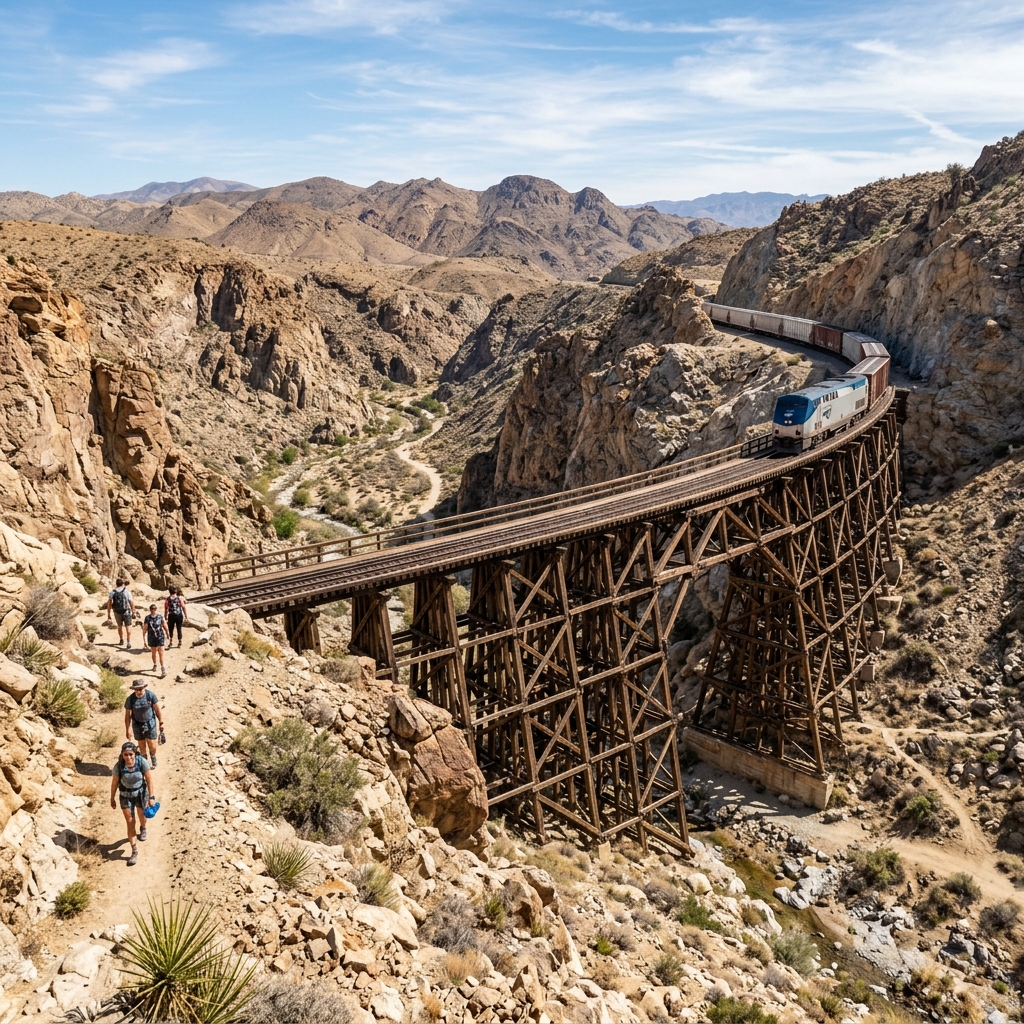
Engineers faced an impossible choice: spend years trying to clear unstable, shifting shale from the buried tunnel, or bypass the shattered mountain entirely by building a bridge across Goat Canyon—a gaping, 200-foot-deep chasm subject to violent desert gale-force winds.
Chief Engineer Chief Engineer F. A. Armstrong made a counter-intuitive decision: instead of steel, they would build the bridge out of wood.
- Thermal Resilience: Carrizo Gorge experiences extreme temperature swings, fluctuating from freezing winter nights to summer baking heat exceeding 120°F (49°C). A steel trestle of this magnitude would expand and contract severely, fatiguing rivets and warping track geometry. Redwood timbers could flex with temperature fluctuations and seismic tremors.
- Logistical Feasibility: Hauling prefabricated steel girders into the roadless, cliff-bound canyon was nearly impossible. Dense, rot-resistant California redwood timbers could be transported by rail to the tunnel mouth and assembled using block-and-tackle cranes and high-tension aerial cables.
- The 14-Degree Arc: The trestle was engineered with an elegant 14-degree curve along its 633-foot span. This curved geometry was deliberate: it allowed the massive timber towers to brace against the ferocious desert windstorms that regularly funnel through the gorge.
Completed in 1933 in just under six months, the Goat Canyon Trestle incorporated over 750,000 board feet of dense redwood. It stood 186 feet high and required not a single nail—held together entirely by heavy iron bolts, tie-rods, and timber split-ring connectors.
The trek to the Goat Canyon Trestle is an advanced backcountry expedition, not a casual day hike. Attempting this hike between May and October is life-threatening due to extreme canyon heat that regularly surpasses 110°F (43°C). The safe hiking window is strictly November through March. From the Mortero Palms trailhead, the route involves rugged, unmarked class 2/3 rock scrambling through dry boulder washes with zero cell reception. Download offline topographic GPS tracks, start at dawn, wear sturdy hiking boots with ankle support, and carry at least 4 liters of water and electrolyte salts per person.
The Modern Ghost of the Carrizo Gorge
Commercial freight and passenger service through the Carrizo Gorge dwindled through the mid-20th century. In 1976, Tropical Storm Kathleen hammered Southern California, unleashing historic desert flash floods that washed out bridges and roadbeds throughout the gorge. Although reopened intermittently by freight short-lines, the line was officially embargoed in 2008.
Today, the Goat Canyon Trestle stands in eerie, silent preservation. The dry desert air has naturally cured the redwood timbers, protecting them from rot and decay.
Walking out to the canyon rim overlooking the structure, the silence is broken only by the wind whistling through the trestle bents. Abandoned vintage train cars, silent tunnel portals, and rusty telegraph wires litter the surrounding gorge, creating one of the most haunting industrial ghost-town landscapes in North America.
Backcountry Route Logistics and Safety
If you are planning to undertake this strenuous desert trek, thorough preparation is mandatory:
- The Mortero Palms Route: The most common legal public approach begins at the Mortero Palms trailhead in Anza-Borrego Desert State Park (accessed via Dos Cabezas Road off Imperial Highway/S2). Reaching the trailhead requires a high-clearance 4WD vehicle.
- Trail Parameters: The round-trip hike covers roughly 6 to 8 miles with over 2,000 feet of punishing elevation change across loose scree slopes, steep boulder dry-falls, and cacti. Allow 6 to 8 hours of daylight.
- Wildlife Awareness: The Carrizo Gorge is a designated ecological sanctuary for the endangered Peninsular desert bighorn sheep. Respect wildlife by keeping your distance and packing out all trash. Watch for southern Pacific rattlesnakes sunning themselves on trail rocks during warmer midday hours.
- Private Property Advisory: The railroad tracks themselves belong to the Metropolitan Transit System (MTS) and are leased to private rail operators. Walking directly on railroad ties or inside unventilated tunnels can constitute trespassing; the safest and most dramatic vantage points are on the public state park ridges overlooking the trestle.


Comments
Post a Comment