Mount Soledad: La Jolla's 822-Foot Summit, Lindbergh’s Gliders, and the 25-Year Battle Above San Diego
Wings Over the Pacific: Charles Lindbergh and the Glider Pioneers
Before radar towers and residential subdivisions conquered the hillside, Mount Soledad was legendary among early aviators for its predictable ocean updrafts. In January 1930, less than three years after his historic transatlantic flight in the Spirit of St. Louis (which was engineered and built right down on Dutch Flats in San Diego), Charles Lindbergh and his wife, Anne Morrow Lindbergh, arrived in town to pioneer unpowered flight.
Teaming up with master sailplane designer Hawley Bowlus, the Lindberghs used the steep western and southwestern drop-offs of Mount Soledad to launch experimental gliders into the coastal thermals. Charles would strap into Bowlus’s wooden sailplane, wait for launch crews to pull the rubber bungee cords taut down the slope, and slingshot out over the canyon toward La Jolla Shores.
Anne Morrow Lindbergh trained relentlessly alongside him on these very slopes. On January 29, 1930, she took off from Mount Soledad, soared smoothly in the ridge lift for over six minutes, and touched down on the beach below, earning her designation as the first woman in the United States to receive a first-class glider pilot’s license. A bronze historical plaque near the memorial’s eastern perimeter quietly commemorates these pioneering flights, which proved that human flight could master thermal aerodynamics without an engine.
Skip the midday tourist rush and arrive 45 minutes before sunset. Walk past the central plaza down to the southern terraced lawn overlooking Pacific Beach and Mission Bay. On ultra-clear evenings, when the sun dips below the Pacific horizon, Mount Soledad offers one of the best elevated perches in Southern California to catch the elusive atmospheric green flash. Afterward, look directly eastward as the city lights of downtown San Diego, the Coronado Bridge, and Tijuana flicker to life simultaneously against the darkening velvet sky.
The 29-Foot Concrete Cross and the 25-Year Constitutional War
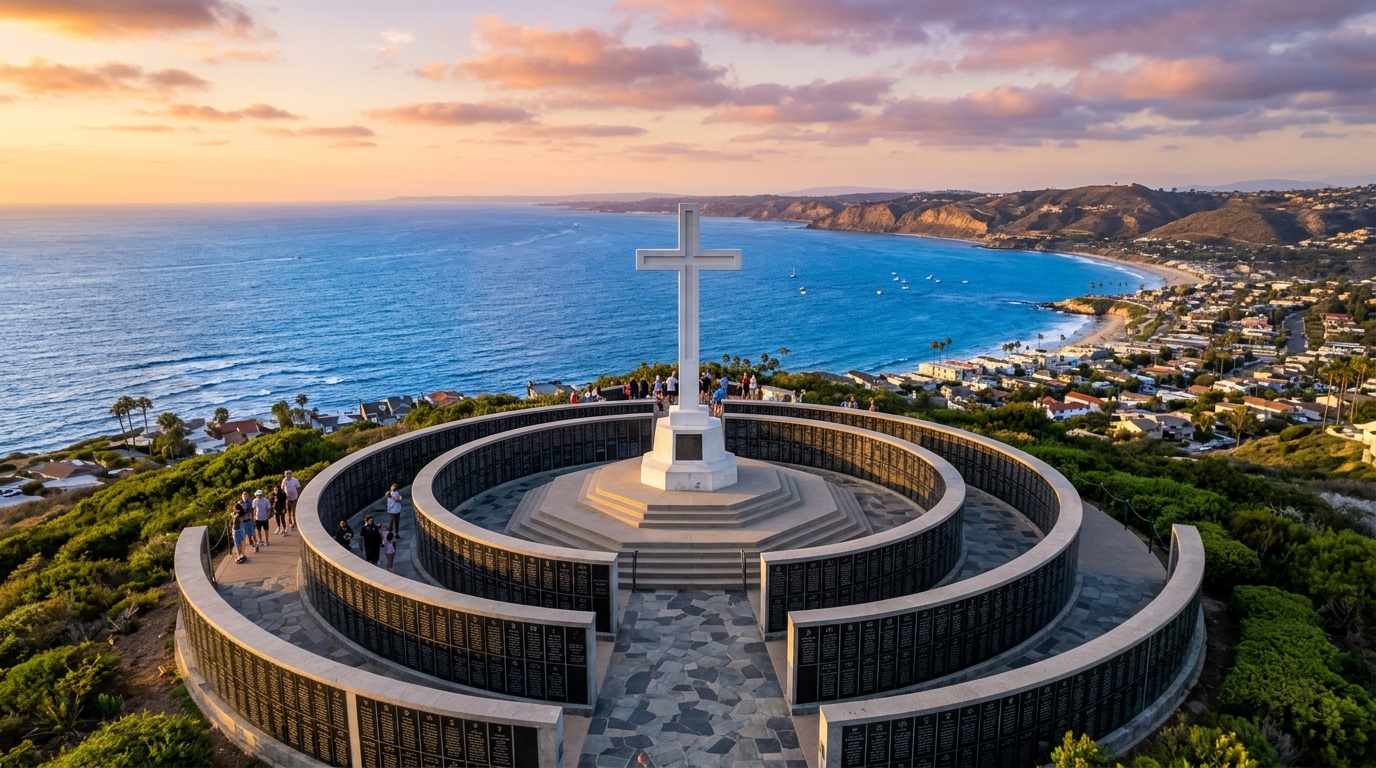
Religious symbols have crowned Mount Soledad since 1913, when local community members erected an initial wooden cross on city land. That primitive timber marker fell victim to windstorms and vandalism, as did a second wooden replacement in the 1920s. In 1952, a group of civic leaders and local veterans organized the Mount Soledad Memorial Association, hiring architect Donald Campbell to design a permanent, enduring structure. On Easter Sunday in 1954, they dedicated the current 29-foot prestressed concrete cross as a lasting monument honoring service members who fought and died in World War I, World War II, and the Korean War.
For three decades, the cross stood quietly against the Pacific sky as a recognized regional navigation landmark for private boaters and military aviators flying out of nearby NAS Miramar. But in May 1989, Philip K. Paulson—a decorated Vietnam War veteran, avowed atheist, and resident of San Diego—filed a federal lawsuit against the City of San Diego with backing from the American Civil Liberties Union (ACLU).
Paulson’s legal argument was straightforward yet combustible: because the cross stood on public city-owned parkland, its prominent religious presence violated the Establishment Clause of the First Amendment and the "No Preference" clause of the California State Constitution. What followed was a 25-year legal odyssey that captivated the nation, involving multiple municipal ballot measures, dozens of federal appeals, intervention by the U.S. Congress, and petitions before the U.S. Supreme Court.
The city attempted to resolve the dispute by auctioning small parcels of the land to private buyers, but federal courts repeatedly ruled the sales unconstitutional. In 2004, the U.S. Congress intervened, passing legislation signed by President George W. Bush to seize the property through eminent domain and designate it a federal military war memorial administered by the Department of Defense. Even that move was struck down by the Ninth Circuit Court of Appeals, which ruled in 2011 that the massive cross still conveyed an unconstitutional sectarian preference.
The marathon legal confrontation was finally resolved in July 2015. Rather than dismantling or relocating the beloved historic landmark, the Mount Soledad Memorial Association purchased the half-acre parcel directly from the Department of Defense for $1.4 million in private philanthropic funds. With the property transferred into private non-profit ownership, the federal court dismissed all pending litigation, permanently preserving the memorial for generations to come.
Black Granite Walls: Preserving Individual Living Memory
What makes the Mount Soledad National Veterans Memorial unique among American military monuments is its individual focus. Most national war memorials commemorate conflicts collectively—listing names on a single wall or celebrating anonymous heroism through sculpture. At Mount Soledad, the memorial is constructed as a series of eleven curved, concentric walls built of polished black anodized granite.
Mounted on these walls are more than 5,800 individual black granite plaques, each etched with a photographic portrait, military service history, branch insignia, and personal reflections from families. The names span every American conflict from the Revolutionary War and Civil War through the global battlefields of World War II, Korea, Vietnam, the Persian Gulf, and modern campaigns in Iraq and Afghanistan.
A walk along the curved walls reveals profound intersections of American history:
- Presidents of the United States: Plaques honor Dwight D. Eisenhower, Harry S. Truman, and Gerald R. Ford, commemorating their wartime leadership and military service.
- Medal of Honor Recipients: Legends of valor including Audie Murphy, the most decorated combat soldier of World War II, and local San Diego heroes like Stockdale and Finn.
- Pioneers of Flight and Space: Aviators such as Charles Lindbergh, James Stockdale, and Mercury astronaut Wally Schirra, alongside Tuskegee Airmen and early naval aviators.
- Ordinary Heroes: Flanking these iconic historical figures are thousands of everyday sailors, soldiers, marines, coast guardsmen, and airmen whose families chose this scenic ridge as their place of perpetual remembrance.
Visitor Logistics and Planning Your Visit
Visitor Essentials & Park Guidelines
- Address: 6905 La Jolla Scenic Drive South, La Jolla, CA 92037
- Park Hours: Open daily from 7:00 AM to 10:00 PM (Gates close promptly at 10:00 PM).
- Admission: Free and open to the public 365 days a year.
- Parking & Accessibility: Free parking is available in two dedicated paved lots on the summit circle. The site is fully ADA accessible, featuring gently sloped ramps leading through all eleven concentric granite memorial rings and the central platform.
- Scenic Driving Tip: Ascend via Nautilus Street from La Jolla Boulevard for sweeping coastal ocean panoramas, or take Soledad Mountain Road from Pacific Beach for wide canyon views. Cyclists often climb Via Capri, but note that its 18% gradient makes it one of the steepest paved climbs in Southern California.


Comments
Post a Comment