Sunset Cliffs Natural Park: Hidden Sea Caves, Spalding’s Sunken Bridges, and San Diego’s Most Dramatic Coastal Bluffs
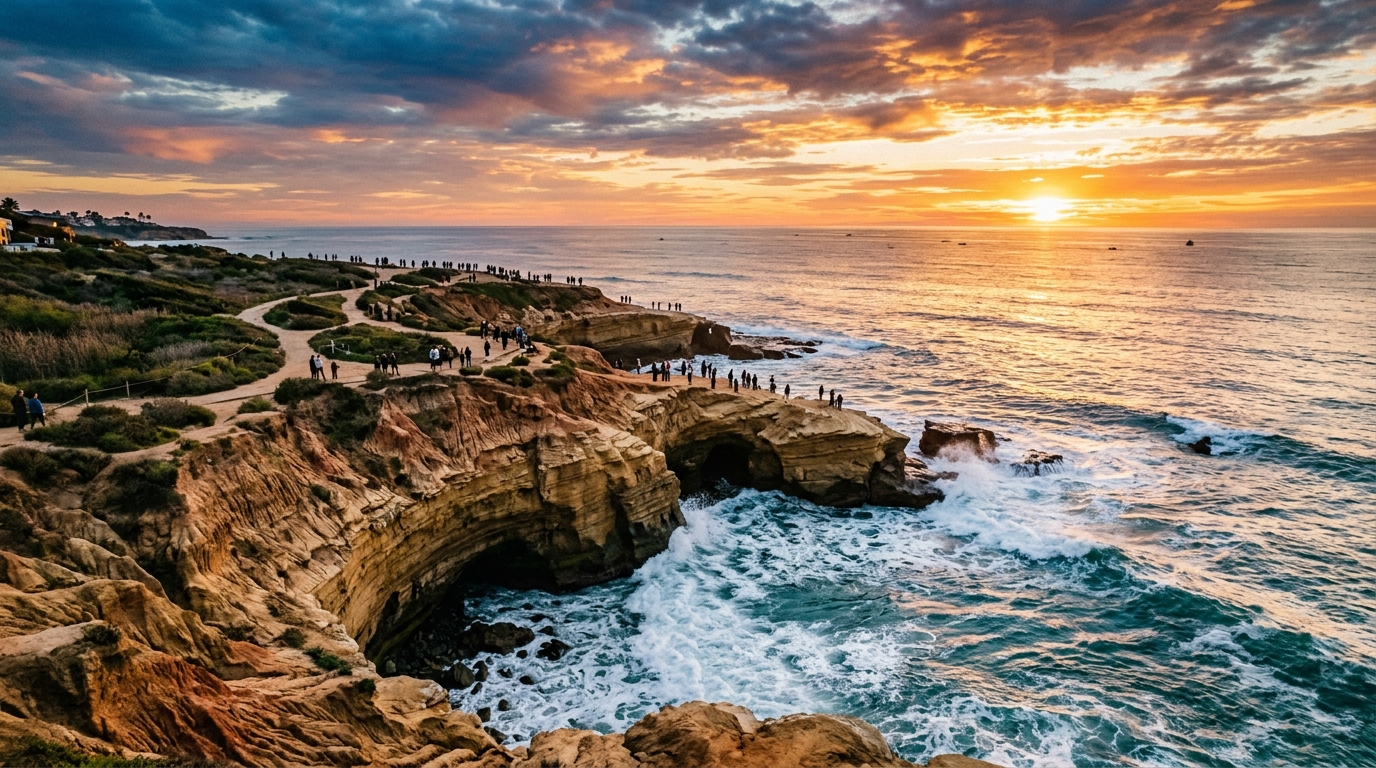
Albert Spalding’s $2 Million Seaside Fantasy
At the dawn of the 20th century, Albert Goodwill Spalding—legendary Chicago White Stockings pitcher, baseball pioneer, and co-founder of the Spalding sporting goods empire—decided to retire to the sun-drenched promontory of Point Loma. Like many wealthy intellectuals of his day, Spalding was drawn to the mystical community of Lomaland, the utopian Theosophical Society headquarters established by Katherine Tingley on the ridge above the cliffs.
In 1915, as San Diego prepared to welcome millions of visitors to Balboa Park for the Panama-California Exposition, Spalding decided to create a coastal rival to the exposition. He poured an estimated two million dollars into transforming the raw, inaccessible ocean bluffs into an opulent public wonderland dubbed "Sunset Cliffs Park."
Spalding hired Japanese landscape engineers and dozens of laborers to execute an astonishing engineering feat:
- Rustic Japanese Bridges: Wood-and-stone arched bridges were slung across deep tidal chasms, allowing visitors in Victorian walking boots and corseted dresses to stroll directly over roaring surf.
- Carved Cliff Stairs & Palapas: Concrete and stone stairways were chiseled into vertical sandstone walls, leading down to palm-thatched observation gazebos and hidden grottos.
- The Tidal Rock Pool: Spalding’s most daring creation was a 15-by-50-foot saltwater swimming pool blasted directly out of the living intertidal reef. It was engineered with stone overflow weirs that allowed every high tide to flush and naturally refresh the pool with fresh ocean water.
The Sea Reclaims Its Due: Erasure and Preservation
Spalding’s dream was short-lived. In September 1915, just months after the park opened, the sporting tycoon suffered a fatal stroke in his Point Loma mansion. Without his fortune to finance constant maintenance, the ferocious Pacific quickly asserted its dominance.
The intense salt spray, winter storm swells, and natural cliff erosion rapidly attacked the wooden bridges and concrete stairs. In 1925, real estate developer John P. Mills purchased the blufftop acreage and subdivided the upper ridge into luxury residential parcels, paving Sunset Cliffs Boulevard. Mills attempted to restore parts of Spalding’s promenade, but by the mid-20th century, the city deemed the deteriorating Japanese structures hazardous and dismantled what the waves had not already washed away.
Today, observant visitors exploring the shoreline at extreme negative low tide can still spot the square concrete footings of Spalding’s bridges embedded in the reef, along with worn chisel marks on the cavern walls—ghostly remnants of an imperial playground swallowed by the tides. In 1983, the City of San Diego formally established Sunset Cliffs Natural Park, permanently protecting the fragile bluffs from commercial development.
Geology of the Point Loma Formation: 75 Million Years of Ocean Power
The striking beauty of Sunset Cliffs is rooted in deep geological time. The cliffs are composed primarily of the Point Loma Formation, an Upper Cretaceous sedimentary sequence deposited between 70 and 75 million years ago when dinosaurs roamed the inland valleys.
Walking the bluff trails, you can clearly trace the contrasting geological strata:
- Sandstone Turbidites: Rhythmic alternating bands of dark, fine-grained mudstone and thick, light-buff sandstone layers created by ancient underwater landslides (turbidity currents) into a prehistoric ocean trench.
- Fossil Shell Beds: Sharp-eyed hikers frequently discover petrified ammonites, bivalves, and gastropods embedded in fallen shoreline boulders.
- Wave-Cut Blowholes & Caves: Because the sandstone varies in hardness, relentless wave action excavates faults into deep caverns. Over centuries, cavern roofs collapse under their own weight, forming dramatic open-air sea sinkholes, such as the famous "Open Ceiling Cave" (Luscomb’s Cave) near Luscomb’s Point.
The sandstone bluffs at Sunset Cliffs are constantly actively eroding and undercut by the ocean. Never walk out onto overhangs or sit with your legs dangling over the edge, even for a photo; sudden cliff collapses occur every winter. For the safest access down to the water and tide pools, use the designated timber stairway at the foot of Ladera Street, and always check the tide tables—accessing the sea caves requires a low tide of -0.5 feet or lower.
Surfing, Tide Pools, and Sunset Rituals
Sunset Cliffs is also sacred ground in Southern California surf history. The reefs beneath the cliffs—known by localized names like Garbage Beach, Subs, New Break, and Luscomb’s Point—generate powerful, long-interval ocean waves that break over sharp cobblestone reefs. Unlike sandy beach breaks, navigating Sunset Cliffs requires scrambling down boulder-strewn goat trails with a surfboard under your arm and timing the surging sets to leap off slippery reef shelves.
For non-surfers, the intertidal zone exposed during winter minus tides reveals one of the richest marine ecosystems in San Diego County:
- Marine Life Encounters: Large colonies of purple sea urchins, giant green anemones, California sea hares, brittle stars, and shore crabs inhabit the rocky basins.
- Whale Watching: From December through April, the high bluffs offer an ideal natural vantage point for spotting migrating Pacific gray whales blowing spouts as they travel between Alaska and Baja California lagoons.
- The Green Flash: Because the park looks out over an unobstructed western ocean horizon, clear winter afternoons offer prime conditions for glimpsing the rare optical phenomenon of the atmospheric "green flash" as the upper rim of the sun disappears.
Actionable Logistics: Planning Your Visit
Here is everything you need to know before visiting Sunset Cliffs Natural Park:
- Getting There: Follow Sunset Cliffs Boulevard south from Ocean Beach. The designated park boundary begins around Adair Street and extends south to the boundary of Point Loma Nazarene University and the Navy facility.
- Parking Options: Several small, free paved parking lots are located along Sunset Cliffs Boulevard (including lots at Luscomb's Point and the southern Hillside Section at Ladera Street). On sunny weekend evenings, these lots fill up an hour before sunset; street parking in the adjacent residential neighborhoods is free but requires walking a few blocks.
- Facilities & Access: The park is kept intentionally primitive and wild. There are no public restrooms, running water, or trash cans along the central bluff trail. Portable restrooms and trash receptacles are located near the Ladera Street southern parking area.
- Footwear & Dogs: Wear sturdy sneakers or hiking shoes with good grip; flip-flops on steep sandstone paths are an invitation to slip. Dogs on leashes are permitted on the upper bluff trails before 9:00 AM and after 6:00 PM (or after 4:00 PM during daylight saving winter hours).


Comments
Post a Comment