Torrey Pines State Natural Reserve: Ancient Conifers, Ocean Bluffs, and the Battle to Save America’s Rarest Pine
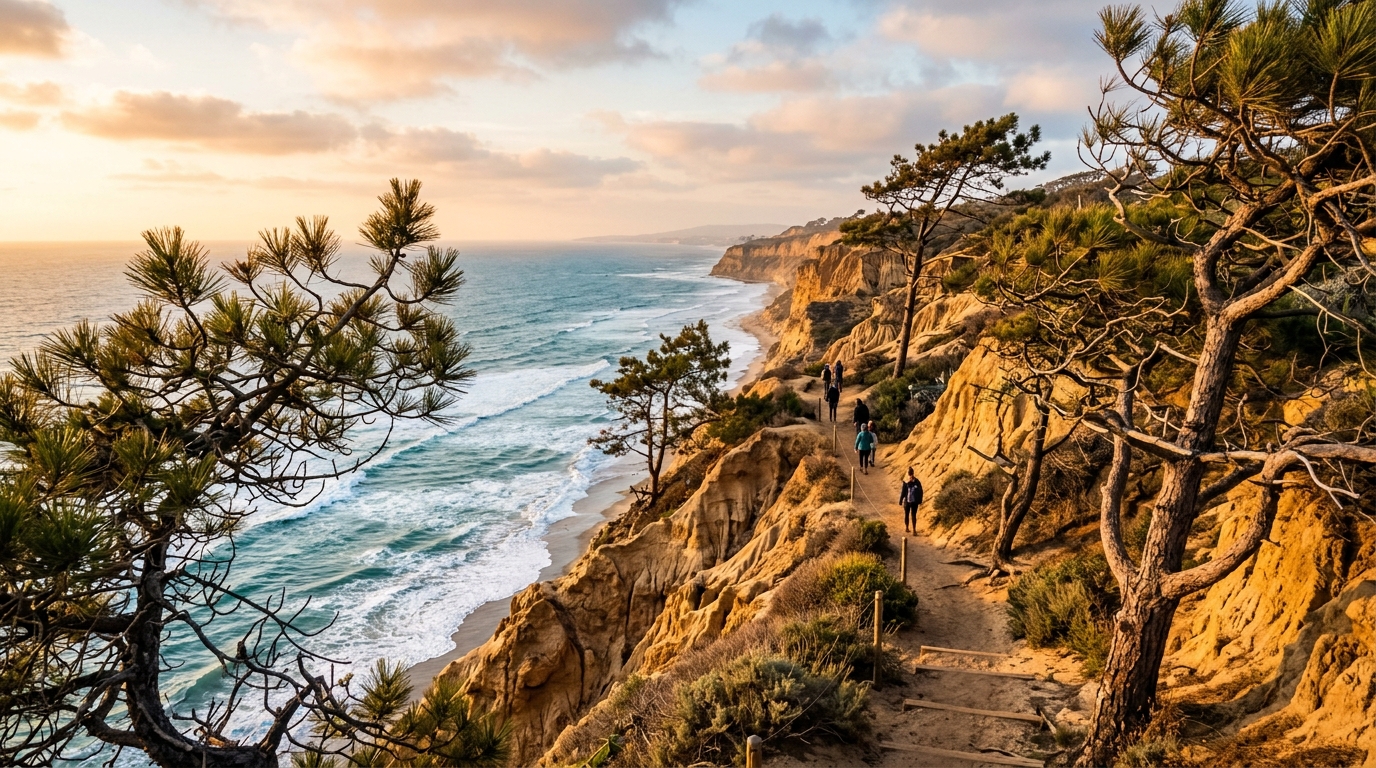
The Botanical Miracle of Pinus Torreyana
Long before Spanish explorers sighted Point Loma, the Kumeyaay people traversed these marine terraces, utilizing the pine nuts for food and weaving baskets from pine needles. European botanists didn't officially document the tree until 1850, when botanist Dr. Charles Christopher Parry, exploring with the U.S.-Mexican Boundary Survey, recognized that this five-needled coastal conifer was an entirely distinct species. Parry named it in honor of his mentor and friend, celebrated American botanist Dr. John Torrey.
What makes the Torrey pine extraordinary is its evolutionary grit. Clinging to nutrient-poor Delmar Sandstone and battered by salt spray, gale-force ocean winds, and summer drought, these trees don't grow straight like mountain timber. Instead, coastal Torrey pines twist into expressive, low-slung sculptures. Their roots can stretch over 200 feet through sandstone fissures to anchor against erosion and siphon deep subterranean moisture, while their long needle clusters excel at harvesting water directly out of thick morning marine fog.
Ellen Browning Scripps and Guy Fleming: The Pioneers Who Saved the Mesa
By the turn of the 20th century, the groves faced imminent destruction. Early motorists were chopping down limbs for firewood, and real estate subdividers were eager to grade the mesa for coastal villas. San Diego civic leaders took an initial step in 1899 by setting aside 364 acres of pueblo land, but the real savior of Torrey Pines was legendary newspaper heiress and philanthropist Ellen Browning Scripps.
Scripps recognized that municipal promises weren't enough. Starting in 1908, she quietly purchased private parcels throughout the groves to shield them from speculative developers. In 1921, Scripps hired passionate field naturalist Guy Fleming to serve as the reserve’s first official caretaker and custodian. Fleming was a conservation visionary: he personally surveyed and laid out the reserve’s iconic trail system, designed master protection plans, and stopped illegal tree-cutting in its tracks.
To welcome travelers navigating the original Pacific Coast Highway (historic US 101), Scripps funded the construction of the Torrey Pines Lodge in 1923. Designed in the evocative Pueblo Revival style by architects Richard Requa and Herbert Jackson using adobe brick, hand-hewn timber, and hopi-style rooflines, the lodge served as a peaceful roadside restaurant and rest stop. Upon her death in 1932, Scripps deeded all her land holdings to the people of San Diego under the strict condition that it remain a permanent natural preserve. In 1959, the city transferred stewardship to the California State Parks system, ensuring permanent state-level legal protections.
Take note of the current park infrastructure project: the upper reserve road, upper parking lots, and upper mesa trails are closed through early 2027 for a major utility overhaul. However, Torrey Pines State Beach remains fully open! You can walk south along the sand at low tide to admire Flat Rock and the towering bluffs from below. Always check local tide charts before setting out along the beach, as high tide pushes crashing surf directly against the sheer sandstone cliffs, cutting off foot passage.
The Crown Jewel Trails: Guy Fleming, Razor Point, and Flat Rock
When the upper reserve trails are open, walking the trails of Torrey Pines is an unforgettable sensory experience. The air smells of sea brine, sun-baked sandstone, and warm coastal pine resin:
- Guy Fleming Trail (0.7-mile loop): The gentlest and most botanically diverse path in the reserve. Winding through dense coastal sage scrub, California encelia, and blooming prickly pear cacti, the loop leads to two dramatic ocean overlooks offering sweeping views of Peñasquitos Lagoon to the north and migrating gray whales offshore during winter.
- Razor Point Trail (1.3 miles round trip): Branching westward across high ocean promontories, this trail delivers dramatic vistas of sculpted sandstone badlands, deep eroded ravines, and the famous geological formation known as Red Butte.
- Beach Trail & Flat Rock (1.5 miles round trip): Descending through dramatic sandstone gorges, this path culminates in a steep wooden and metal staircase that deposits hikers directly onto the Pacific shoreline next to Flat Rock—a massive sandstone shelf extending out into the crashing surf.
Strict Reserve Rules: Why You Can’t Bring Your Dog or Sandwich
Because Torrey Pines holds "State Natural Reserve" status rather than standard "State Park" status, the rules are considerably stricter than most visitors expect:
- Zero Food on the Trails: Picnicking and food consumption are strictly forbidden anywhere past the parking lots. Squirrels and birds that ingest human food lose their natural foraging behavior, and discarded fruit peels disrupt the delicate micro-ecosystem. Water in reusable bottles is the only consumable permitted.
- No Dogs Allowed: Dogs are prohibited everywhere within the reserve and beach boundaries, even inside parked cars. Canine scents cause severe stress to native wildlife like gray foxes, mule deer, and bobcats.
- Stay Strictly on Marked Trails: The yellow and red Delmar Sandstone is exceptionally fragile. Stepping off-trail causes accelerated erosion that can wipe out rare seedlings and destabilize cliff edges. Rockslides happen unpredictably; stay well clear of cliff overhangs both above and below.
Actionable Logistics: Planning Your Visit
Here is everything you need to know when visiting Torrey Pines:
- Hours: Gates open daily at 7:15 AM and close promptly at sunset. Vehicles left inside after closing are subject to citations.
- Vehicle Day-Use Fees: Demand-based pricing ranges between $15 and $25 per vehicle depending on the season and day of the week. California State Parks annual passes are accepted at the South Beach kiosk.
- Public Transit & Biking: The North County Transit District (NCTD) Breeze Bus Route 101 runs along North Torrey Pines Road and stops directly at the park entrance, making car-free transit from Old Town or Solana Beach hassle-free.
- Visitor Center & Museum: Housed inside the historic 1923 Pueblo Revival Lodge on the upper mesa, featuring interactive botanical displays, historic photographs of Guy Fleming, and a volunteer docent desk.


Comments
Post a Comment