The Wobbly Bridge of Bankers Hill: Edwin Capps, Maple Canyon, and San Diego's Secret Urban Trails
Walk across the intersection of Spruce and Brant Streets in Bankers Hill on a breezy afternoon, and from fifty feet away, everything looks like an ordinary, sedate San Diego residential lane lined with Queen Anne cottages, Craftsman bungalows, and swaying fan palms. Then the asphalt abruptly surrenders to a pair of weathered concrete abutments, two sets of heavy steel suspension cables plunge through iron saddles, and the ground drops completely out from beneath your feet.
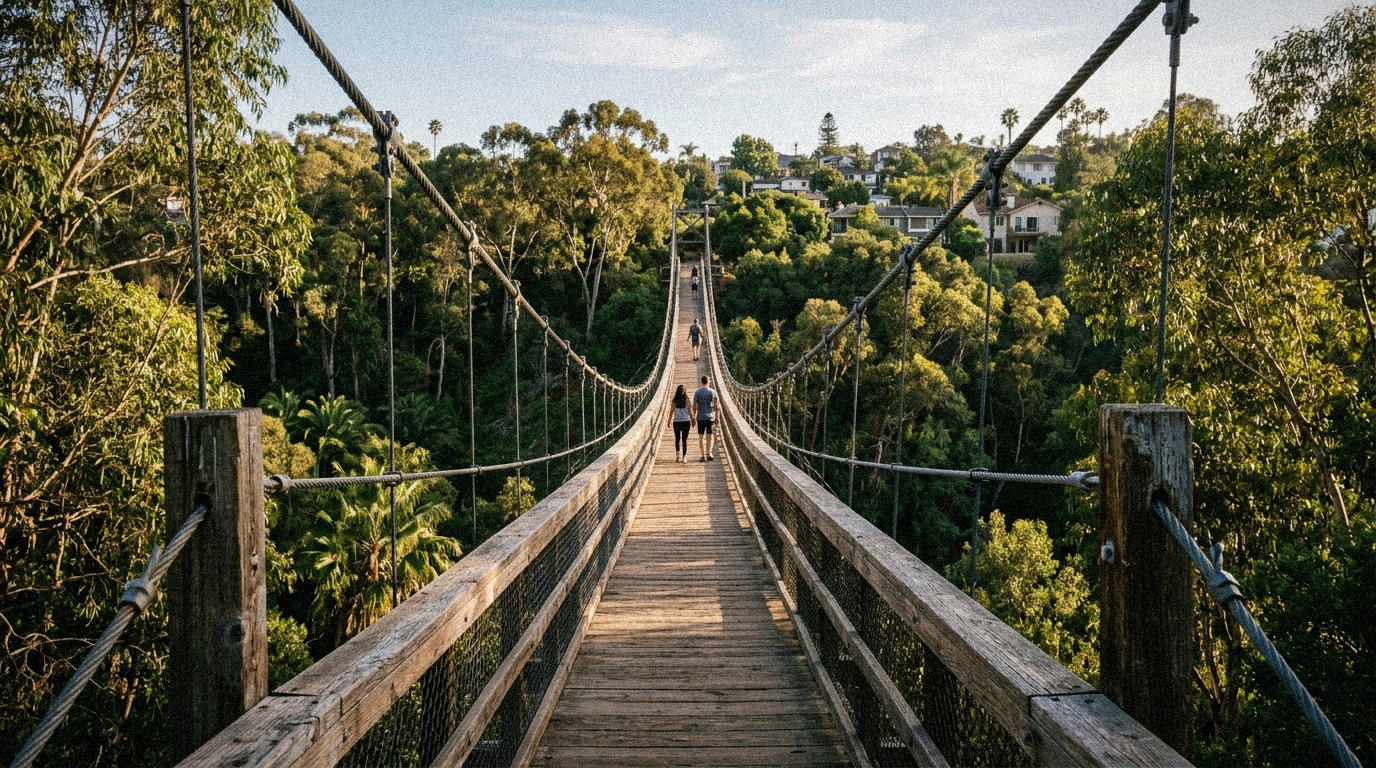
You are standing at the threshold of the Spruce Street Suspension Bridge—often affectionately christened "the Wiggly Bridge" by third-generation locals. Stretching 375 feet across the wooded abyss of Maple Canyon (historically known as Kate Sessions Canyon), this narrow wooden catwalk is not merely an architectural novelty. It is a living, swaying, century-old monument to an era when San Diegans navigated their deeply creased coastal geography on foot, powered by nickel streetcars and sheer civic audacity.
Edwin Capps and the Streetcar Commute of 1912
To understand why a soaring suspension footbridge exists in the middle of a quiet uptown residential neighborhood, you have to rewind to San Diego in 1912. The city was preparing for the landmark 1915 Panama-California Exposition in Balboa Park. Electric streetcars operated by John D. Spreckels’ San Diego Electric Railway buzzed steadily along Fourth and Fifth Avenues, whisking commuters straight down into downtown's bustling waterfront and commercial core.
The problem was topography. San Diego is defined by mesa tops fractured by steep, crumbly coastal canyons. Residents living on the western finger of Bankers Hill along Brant and Curlew Streets could physically see the streetcars rumbling along Fourth Avenue just a few blocks east, but between their front porches and the tracks lay an impassable 70-foot-deep gorge choked with chaparral, coastal sage scrub, and seasonal mudslides. Reaching the trolley required a tedious, lung-busting detour around the canyon rim.
Enter Edwin M. Capps. A civil engineer who served as San Diego’s City Engineer and would later be elected mayor twice (in 1899 and again in 1915), Capps approached urban infrastructure with practical flair. Rather than grading and filling the canyon at immense expense, Capps drafted blueprints for a pedestrian suspension bridge. Completed in 1912 at a modest taxpayer cost of roughly $19,000, Capps' bridge provided neighborhood residents with a direct, level, five-minute walk across the canyon straight to the trolley stop.
Engineering the "Wiggly Bridge": Grace, Gravity, and Steel
Unlike rigid truss crossings or heavy masonry viaducts, suspension bridges are dynamic structures designed to dissipate kinetic energy through flexure. Capps designed the Spruce Street span with two pairs of main 1.5-inch steel wire cables, draped over steel tower bents and secured deeply into concrete anchor blocks buried beneath street grade on either mesa.
Lattice iron suspender rods drop from the main cables to support timber crossbeams and a plank deck barely four feet wide, framed by waist-high wire mesh railings. Because the bridge was engineered specifically for foot traffic rather than vehicular loads, it lacks heavy lateral stiffening trusses. Step onto the span, and you immediately feel the bridge breathing beneath your shoes.
When an offshore breeze pushes up through Maple Canyon, the bridge gently rocks in a rhythmic, undulating sway. When two people walk in lockstep—or when playful schoolkids jog across—the deck dances with an elastic bounce that has startled uninitiated visitors for more than 110 years. Rest assured: the engineering is exceptionally sound. Caltrans, the City of San Diego, and structural engineers routinely inspect the suspension hardware and anchorages, confirming that Capps’ graceful pedestrian link remains structurally rock-solid.
Visit just before sunset on a quiet weekday. Stand dead-center on the bridge, grip the cable rail, and hold completely still for sixty seconds. As the Pacific breeze rolls in off San Diego Bay, you will feel the bridge softly oscillate while looking directly through the floorboards at the tree canopies 70 feet below. Keep your camera secured on a wrist strap—dropping a phone through the plank gaps means a rough hike down into the brush.
Maple Canyon Trail: The World Beneath the Span
Walking across the bridge gives you a bird’s-eye perspective of the canyon canopy, but the full experience requires dropping down into Maple Canyon itself. An inconspicuous trailhead near the eastern bridge abutment descends along a switchbacking dirt path into the cool, shaded belly of the canyon.
Down on the canyon floor, the hum of city traffic evaporates. Towering eucalyptus trees, planted in the late 19th and early 20th centuries as prospective railroad timber, filter the southern California sunlight into dappled gold. The trail meanders beneath the Spruce Street Bridge, offering a dizzying upward view of Capps’ steel undercarriage and timber stringers suspended against the sky like a giant spiderweb.
Maple Canyon is also a critical wildlife corridor and an anchor segment of San Diego’s legendary "Seven Bridges Hike"—a 5.5-mile urban walking loop that traverses the city's historic spans, including the 1905 Quince Street timber trestle, the concrete arches of First Avenue, and the magnificent Cabrillo Bridge entering Balboa Park. As you walk the dirt floor, watch for Cooper's hawks hunting in the branches, brush rabbits darting through sumac, and the purple blooms of native coastal sage.
Location & Visitor Logistics
Visiting the Spruce Street Suspension Bridge
- Location: Spruce Street at Brant Street (West entrance) or Spruce Street at Front Street (East entrance), Bankers Hill, San Diego, CA 92103.
- Hours: Open daily, 24 hours. Best experienced from sunrise to sunset for optimal trail safety and photography.
- Admission: Free.
- Parking: Free street parking is available along Spruce Street, Brant Street, and Front Street. Be respectful of residential driveways.
- Trail Access: The Maple Canyon Trail can be accessed from the eastern abutment near Front Street or from the canyon entrance at Redwood and Fourth Avenue.
- Bridge Etiquette: Intentional excessive jumping or swaying is prohibited to respect elderly walkers and preserve the century-old cable fittings.


Comments
Post a Comment